

How Are Colors Represented In Svg Animation
by Surbhi Oberoi
How to Pattern, Code, and Animate SVGs
Y'all can think of Scalable Vector Graphics (SVG'southward) equally responsive graphics. SVG is an XML-based format that allows you to create an image by using defined tags and attributes. Your code will render an image that yous tin can edit right in your code editor.
Here's a sample SVG. If you wait at its code, you'll notice that it'southward made upward of tags and attributes, but like an HTML document. The whole thing is independent inside <svg> tag. Offset, there's a <rect> tag with black strokes and white fill. And inside that, at that place's an ellipse (almost a circumvolve, but observe the ry and rx attributes) which is filled with ruddy color.
We can use SVG on the web in two ways. We can use the SVG files as the src attribute of <img> tags. And then, you can have <img src="japan.svg"> similar you lot would do with PNGs and JPEGs.
But, the more interesting instance (in case y'all have noticed that the tags take an id aspect like HTML) is that nosotros tin directly paste the source of the SVG in a <div> inside our HTML. We can so style these divs like individual building blocks — or even groups of building blocks — the way we want. We can apply CSS, animations, or fifty-fifty add interactivity using JavaScript. This is what makes SVGs i of the most versatile and hottest chemical element right now in HTML.
SVGs are infinitely scalable, responsive, take smaller file size, are future-proof for next-generation bazillion-pixel dumbo screens, and can be styled, animated and interacted with using known web technologies — namely CSS and JavaScript.
Notice that all these things were previously possible only with a Flash embed — which required a wink histrion and lots of specialized work. And there's no dear going around for Wink these days.
Vector vs Raster images
Raster images are made up of pixels to form a consummate prototype. JPEGs, GIFs and PNGs are common raster prototype types. Virtually all of the photos found on the web are raster images.
Raster images consist of a fixed number of pixels, and so resizing them without effecting their resolution is non possible. You may have noticed that resizing most images gives them a grainy, and blurry await. That's because of their stock-still pixel count.
Hither'south what happens when you zoom in on a raster prototype:

Vector images, on the other hand, are flexible and resolution-independent. They are constructed using geometric shapes — lines, rectangles, curves — or a sequence of commands. You lot can edit their attributes, such as color, fill, and outline.
Ane mutual utilise for vector images is icons and small-scale icon animations. These will appear crisp, fifty-fifty on the highest density displays such as upcoming 4k smartphones.
Here'south what happens when y'all zoom in on a vector prototype:

SVG tags
<southvg>
The <svg> tag embeds an SVG certificate inside the current document, HTML for instance. The tag has its own x and y coordinates, height and width, and its ain unique id.
Here's what an <svg> tag might await like:
<svg width="580" tiptop="400" xmlns="http://www.w3.org/2000/svg"> <;g>
The <g> tag groups the elements together, and acts like a container for related graphic elements. A <g> element can even contain other <g> elements nested within it.
Here'due south an example of a <g> tag:
<g> <title>groundwork</championship> <rect fill="#fff" id="canvas_background" height="402" width="582" y="-1" 10="-one"/> <g display="none" overflow="visible" y="0" x="0" pinnacle="100%" width="100%" id="canvasGrid"> <rect fill="url(#gridpattern)" stroke-width="0" y="0" 10="0" height="100%" width="100%"/> </chiliad> </yard> <rect>
The <rect> element is an SVG basic shape representing a rectangle. The chemical element can have various attributes, similar coordinates, height, width, fill color, stroke color, and precipitous or rounded corners.
Here'due south an example of a <rect> tag:
<rect id="svg_1" acme="253" width="373" y="59" x="107.v" stroke-width="ane.5" stroke="#000" fill="#fff"/> <use>
The <use> element allows you to clone and reuse the graphical SVG elements including other elements similar <g> <rect> as well as other <use> elements.
Here'southward an example of a <apply> tag:
<text y="15">black</text> <use x="50" y="10" xlink:href="#Port" /> <text y="35">scarlet</text> <employ x="50" y="30" xlink:href="#Port"/> <text y="55">blue</text> <use x="50" y="50" xlink:href="#Port" fashion="make full:blue"/ <pathursday>
The <path> element defines a path of coordinates for a shape. The lawmaking for path tag might seem cryptic, but don't be intimidated. The following example code tin can be read like this:
1. "M150 o" — Movement to (150,0)
two."L75 200" — Draw a line to (75,200) from last position (which was (150,0)
3. "L255 200" — Draw a line to (225,200) from last position (which was (75,200)
four. "Z" — Close the loop (draw to starting indicate)
You lot probably don't need to learn this since the lawmaking for path tin can be generated in any SVG editor, just it'south cool to know.
Here'south an example of a <path> tag:
<svg top="210" width="400"> <path d="M150 0 L75 200 L225 200 Z" /> </svg> <symbol>
Finally, the <symbol> chemical element defines symbols that are reusable. These symbols tin can only exist rendered when called past the <utilize> element.
Hither'due south an example of a <symbol> tag:
<svg> <symbol id="sym01" viewBox="0 0 150 110"> <circumvolve cx="50" cy="fifty" r="40" stroke-width="8" stroke="red" fill="ruddy"/> <circle cx="90" cy="60" r="xl" stroke-width="8" stroke="greenish" make full="white"/> </symbol> <use xlink:href="#sym01" x="0" y="0" width="100" meridian="fifty"/> <use xlink:href="#sym01" ten="0" y="50" width="75" pinnacle="38"/> <use xlink:href="#sym01" 10="0" y="100" width="50" height="25"/> </svg> Creating SVGs
There are plenty of SVG editors available, like Adobe Illustrator, and Inkscape, which is free and open source. Since SVG files are plain-text XML, you could also hand-code one in a pinch.
For this example I'll use a unproblematic online editor where yous can design SVGs without having to install anything.
- Get-go create a circle
ii. Next add more than circles and salvage the source code
CSS3 animations
SVGs can be animated by adding an id or a class to the SVG path in the lawmaking and then styling it in CSS3 like any other document. Below is an case of how SVGs can exist animated.
CSS3 animation offers a variety of blitheness types that yous can chose from. Line blitheness is another cool attribute of SVG.
For this next example, I wrote the text "Hullo, I am Surbhi" using pen in the editor. And so I used CSS3 keyframes again to animate the stroke.
Notice that each path has a unique id. That is because the filibuster in the animation is important when animating a stroke with more than i give-and-take.
The <animate> tag animations
<animate> is an blitheness tag built into the SVG element itself. It defines how the aspect of an element changes from the initial value to the stop value in the specified animation duration. This is used to animate properties that cannot be animated past CSS alone.
The mutual elements of the breathing tag are color, motion, and transform.
The animate tag is nested inside the shape tag of the object that has to be animated. Information technology does not piece of work on the path coordinates, but only inside the object tags. Notice the additive attribute. Information technology signifies that the animations do not override one another but instead work together at the same time.
Here'southward an instance of animating an SVG using the HTML5 animate tag:
JavaScript based animations and interactivity
Since SVG is just a document with tags, we can also use JavaScript to interact with individual elements of the SVGs by getting hold of their selectors (id or class).
Apart from vanilla JS, in that location are diverse JavaScript libraries available for animating and interacting with SVGs like Vivus.js, Snap.svg, RaphaelJS, and Velocity.js.
In the following example, I have used the Vivus.js library along with jQuery to achieve a line stroke animation.
Why non use SVGs for all images?
SVGs are by and large suited for images that tin exist constructed with few geometrical shapes and formulas. Though, in principle, you can convert anything like your photograph to SVG, the size of the image would be several megabytes, thus defeating the space-saving purpose of using SVGs. You're better off using SVGs for icons, logos, and pocket-size animations.
Here is something I created while I was learning almost SVGs, using CSS and SVGs, without any libraries. (Don't Judge!) https://github.com/surbhioberoi/surbhi.me
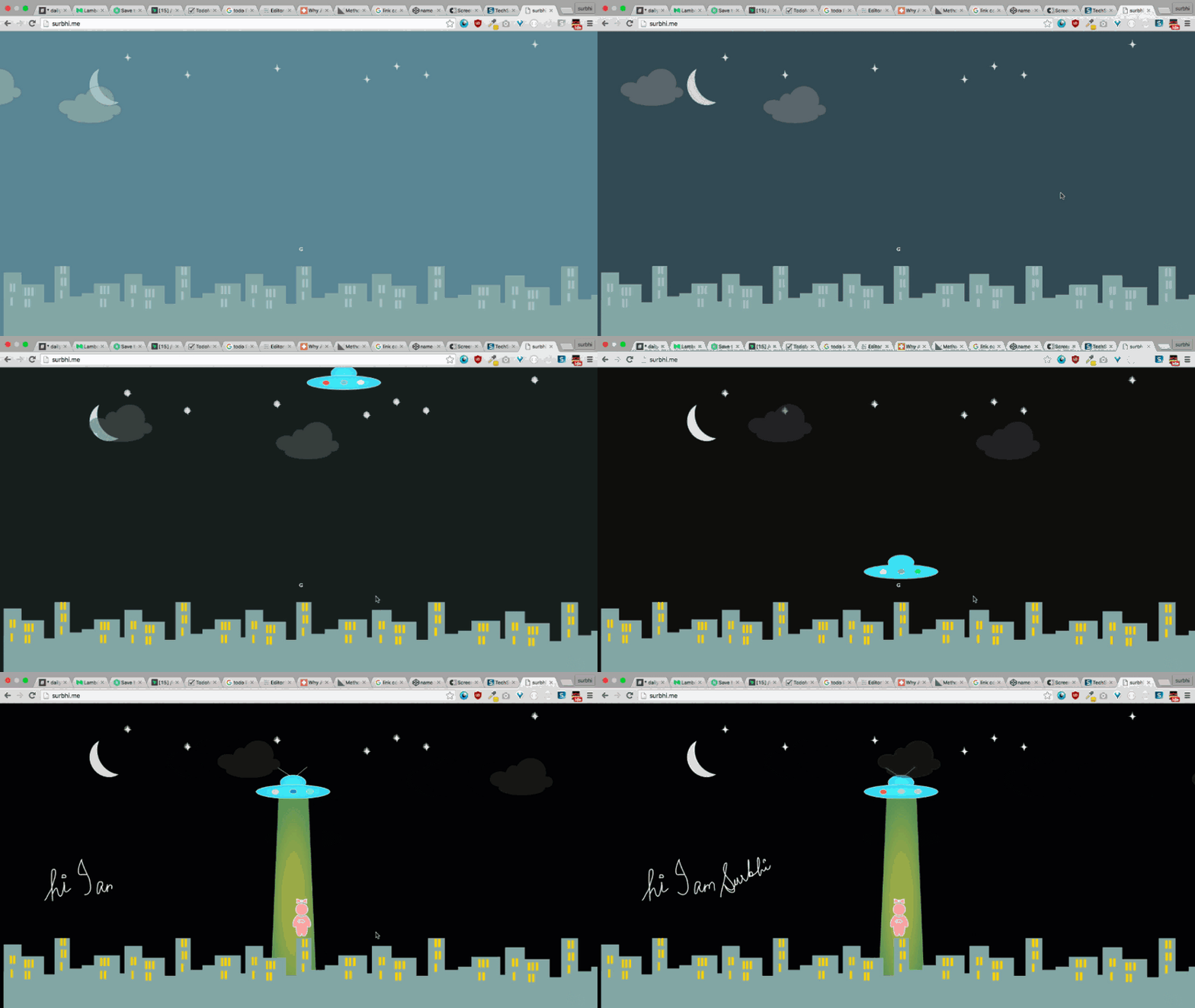
Originally published at surbhioberoi.com on July 12, 2016.
Acquire to code for free. freeCodeCamp's open source curriculum has helped more than twoscore,000 people get jobs as developers. Go started
Source: https://www.freecodecamp.org/news/a-guide-to-svg-on-web-c5932dadca03/
Posted by: deanclinter46.blogspot.com
0 Response to "How Are Colors Represented In Svg Animation"
Post a Comment