

Which Animal Is Born With Horns Giraffe Buffalo Rhinoceros Or Reindeer
Many animals with horns can exist constitute on the African continent. Unfortunately, many of these are hunted for their horns. Some species face most extinction purely considering they are animals with horns!
However, millions of these animals nevertheless cover the African savanna. There are many graceful herds of the Bovidae family unit to capeesh. Here is everything you need to know near animals with horns.
Animals With Horns or Antlers?
The semantics of language has resulted in horns beingness used to draw the headgear donned by most African animals.
The term antlers refers to the structures on the head of well-nigh North America dwelling animals, like caribou.
It'due south easy to assume the two terms are interchangeable and merely exist as a consequence of American English versus UK English language.
In actual fact, horns and antlers accept significant differences in their purpose, construction, growth, and the animals on which they tin can exist found.
Antlers
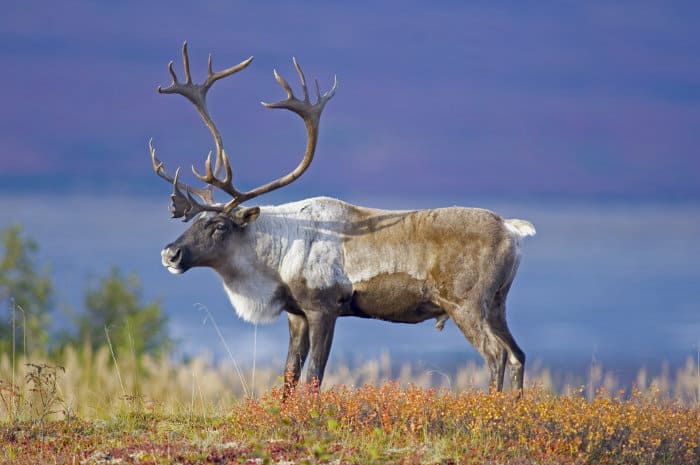
Antlers grow on the Cervidae family of animals, such as moose, elk and deer.
Antlers are usually covered in a velvety growth as opposed to the difficult keratin of horns.
Over time the velvet texture disappears and the antlers become polish and shiny.
Horns

Horns, on the other hand, belong to the Bovidae family unit.
This includes various species of antelope and gazelle besides as cows, sheep, and goats.
Horns are coarse and rough. Merely like human nails they proceed to grow throughout an fauna'south life, accounting for scrapes and activities that wearable them down.
How to Instantly Tell Horns From Antlers
Horns tin can be distinguished from antlers instantly – horns are one solid structure. They tin can twist or curve, protrude far or barely show, but they are also one solid mass. Antlers fan out into branch-like shapes or fingered structures.
Discover African Animals With Horns
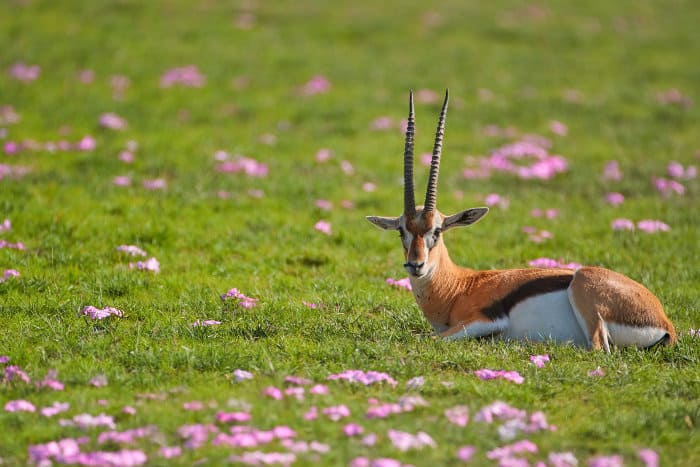
Gazelle
At that place are over 14 unlike types of gazelle falling under the antelope genus as a group called Gazella.
Of the xiv, half-dozen are found in Africa, including the Dorcas gazelle which is found in the Sahara Desert and throughout the Northern regions of Africa.
Grant's gazelle are some of the tallest gazelles, and the slender-horned gazelle is now an endangered species due to a loss of habitat and human expansion.
Other species of gazelle that are found in Africa include Speke's gazelle, Thomson's gazelle, and dama gazelle.
African gazelles' horns
Both males and females grow horns (with a few exceptions). All the same, in many instances the females have shorter horns than the males.
Male person gazelles have longer horns than females in order to win say-so. A dominant male establishes himself by challenging others with their horns.
Horns also serve the purpose of protecting the fawn (the offspring). It is believed that the females are naturally attracted to males that are equipped with horns for this very cardinal purpose.
Impala
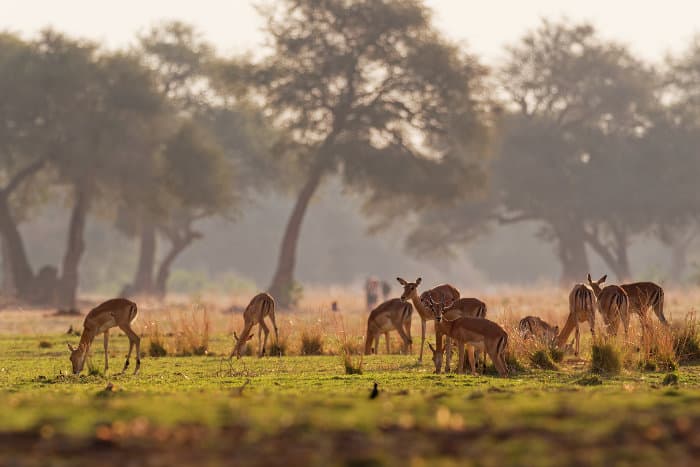
The impala is one of the almost mutual antelope species in Africa. They're unbelievably swift runners and their impressive leaps have been measured to exist as loftier every bit 3 metres in the air, and 10 metres in length!
If at that place is danger about, they alarm the herd by making a loud barking dissonance. When food and h2o are plentiful, they tend to break into smaller groups.
When scarcity hits during the dry flavor, impala come together in groups as big as 100-200 individuals, to search for nutrient and water together.
Impala horns
Merely the male impala abound horns. These horns tend to be nighttime in colour and curve outwards from the impala's head, significant the tips are far apart.
Being splayed apart enables male person impala to lock horns with other males when they compete for authorisation.
They're usually effectually 70 cm in length and have ridges. The horns are strong enough to survive combats between males, but they are hollow inside, and a cross-section is circular.
Females are able to extend their pregnancy by as much equally a whole month if they feel unsafe or if there is too picayune food bachelor!
Kudu
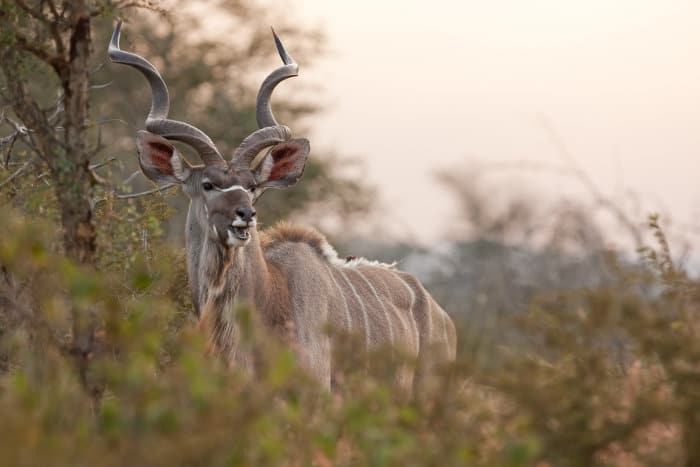
One of the largest members of the Bovidae species, greater kudu tin stand as high equally 150 centimetres!
Kudu males (known as bulls) are likewise easily recognised past their impressive horns. Some of the longest animal horns ever measured and recorded were 180 centimetres in length. And they belong to the kudu.
Only the bulls have horns so it's easy to distinguish male person kudu from female kudu. The females are also far more petite and shorter.
Kudu horns
Kudu horns are regal and beautiful. They are widely sold for their decorative qualities. Many African tribes too purpose them into musical instruments.
They are hollow, which means they tin can serve as containers. They're besides used in traditional African rituals and practices.
These animals use their horns in combat with other males to constitute dominance. The spiral shape allowing them to interlock easily.
Gemsbok
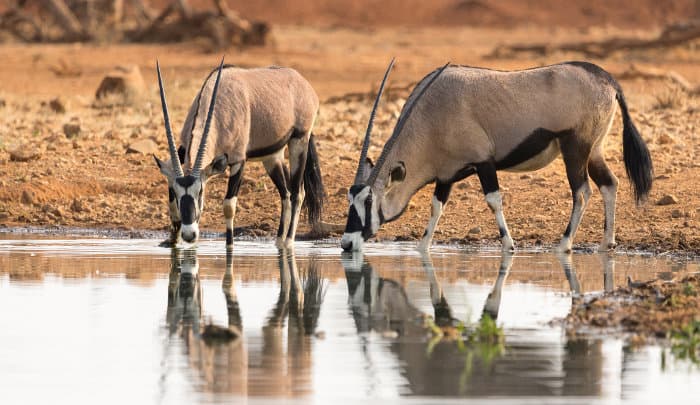
There are two main varieties of gemsbok. The southern gemsbok is typically institute in arid regions similar the Kalahari. In the open grasslands of the more northern parts of Africa (mainly Due east Africa) y'all will observe the northern gemsbok (oryx).
Gemsboks enjoy each other's visitor and generally class groups of around ten individuals. If food and h2o get scarce, they form smaller groups or even wander off every bit individuals.
These elegant antelopes can be incredibly unsafe, using their horns by lowering the head and charging. This defence is so lethal they have niggling need to run from predators.
Gemsbok horns
The gemsbok is sometimes called the sabre antelope, named for the lethal horn which can spear an opponent or potential threat. In fact, the tips are so sharp and dangerous, many African tribes employ them equally points for their spears.
Both males and females take horns, although the females' horns are significantly more than slender than the horns of the males. The horns extend fairly directly forrad at an impressive 83 centimetres.
Waterbuck
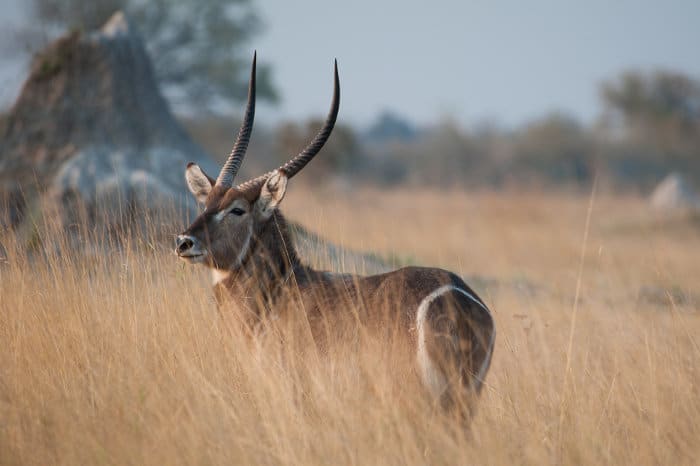
There are 2 species of waterbuck, the defassa and mutual waterbucks.
They are some of the most foul-smelling animals on the African plains. Their shaggy brown coats secrete an oily substance, presumably for waterproofing, which is incredibly evil-smelling.
Waterbucks live in woodlands, savanna grasslands, and anywhere nearby a stable water source. Living so shut to water usually means they take access to an affluence of nutrient. They tend to graze on the tougher grasses other animals ignore.
Waterbuck horns
Waterbuck horns are long and curve slightly. They never stop growing, which ways the length of the horn indicates an animal's historic period. Just male waterbucks volition grow horns, the females practice non.
The males may use their horns to ward off predators and also to establish dominance when they are sexually mature. In combat with other males, the collision can get intense. Often, the combat is only ended when one of the two is expressionless.
Springbok
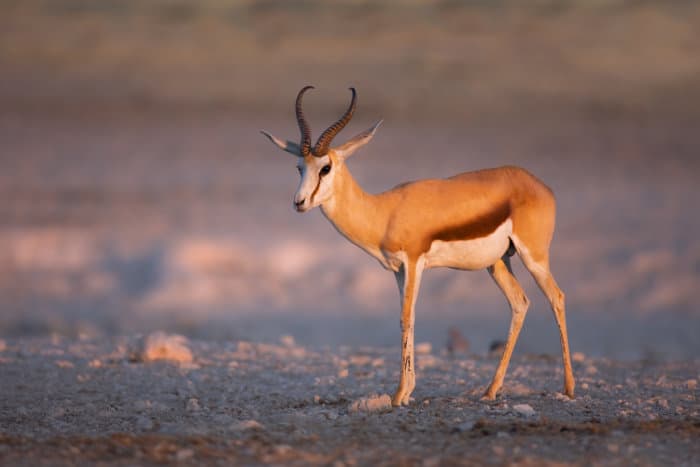
Springboks are one of the smaller animals with horns in Africa. The females tend to form a herd of their own, where they heighten their young.
The herd will likewise contain a few males who have proved their dominance. Springboks are named for their impressive bound – as high every bit 3.5 metres!
It is idea that the purpose of these leaps is to distract predators. The proper term is pronking.
Springboks will feed on near institute types, depending on the season and availability. They prefer plants and flowers with higher h2o content, but will happily graze on grasses too.
Springbok horns
Males and females have a set of horns. Their horns are fairly modest in size at effectually 50 centimetres in length but boast a beautiful black color. They curve backwards and contain evenly spaced ridges from the base to the tip.
Eland
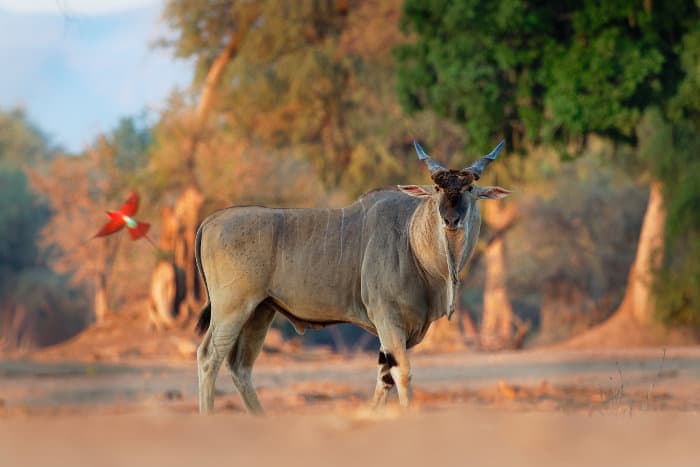
This animal with horns is the slowest member of the antelope family. Eland are also 1 of the largest animals with horns in Africa. They can grow upwardly to 3 metres in length and can weigh up to 900 kg.
If h2o is very deficient, the eland can really reduce its water metabolism by increasing its trunk temperature. This enables them to survive in the semi-arid terrain of Africa – from Southern Africa up to Ethiopia, Angola, and even Malawi.
In Africa, there is a tendency towards keeping eland in place of cattle. They are hardier and more drought-resistant. Their meat and milk are considered suitable substitutes.
Eland horns
Eland horns are not very long or peculiarly spectacular, but they serve the eland perfectly. Both males and females grow horns – the males' horns tend to be shorter and thicker and the females' are longer and thinner.
The horns have a twist towards the base of operations and curve outwards to class a V shape. They can usually abound upwards to seventy centimetres in length.
Bongo
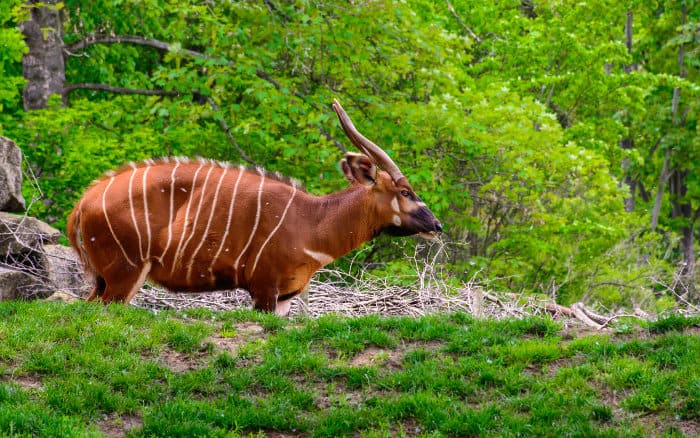
There'south a belief among sure African cultures that these animals can induce seizures in people. As a result, superstition and beliefs crusade them to avert encounters with bongos.
Bongos are among the larger members of the antelope family. There are two genera of bongo; lowland (western) and mountain (eastern).
They have excellent hearing and are capable of reaching epic speeds of around 60 km/h when they are pursued by a predator.
The males live solitary while the females class groups (herds) and raise their immature together. A grouping typically contains 5-40 individuals plus their offspring.
Bongo horns
These beast horns can reach an astounding 99 centimetres in length! Both males and females are equipped with a ready of twisted, lyre-shaped horns. The horns are more spectacular in the males who tend to have more twists and girth.
Wildebeest
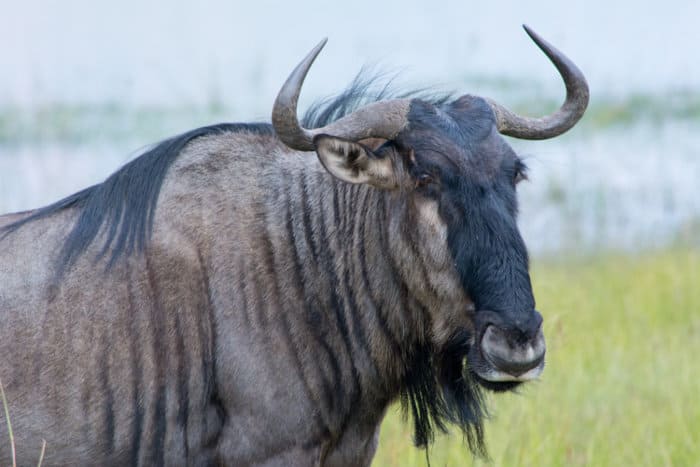
Easily recognised by their anvil-shaped head, wildebeest have get something of an icon when the African plains come to listen. They're nicknamed "the poor man's buffalo".
1 of the traits that make them so distinguishable is the size of their herds. When the rains move across E Africa, over one meg of these animals course the great wildebeest migration and movement to fresh pastures.
There are two species of wildebeest and the blueish wildebeest is the one most people place with. It'southward not blueish, rather, its dorsum is a silver colour while its head is black.
The black wildebeest is similar just much darker all over. From a distance, it looks black, but at closer inspection, information technology is really brown.
Wildebeest horns
In wildebeest, both males and females grow horns, however, the males have substantially thicker and larger horns. An adult male's horns tin can accomplish a width of around fifty centimetres.
The horns are used by the males to impress females. They do this by bellowing and thrashing in a typical display which helps to establish territory.
Cape buffalo
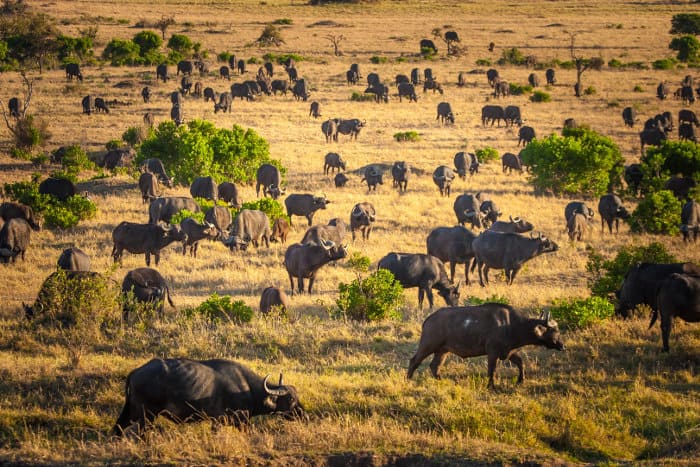
Also called the African buffalo, this gigantic bovine dwells in the plains of Africa, relishing swamplands and savanna terrains.
They're one of the largest and nigh successful grazers.
In that location are four subspecies of buffalo including the African forest buffalo, the Westward African savanna buffalo, the fundamental African savanna buffalo, and the southern savanna buffalo or Cape buffalo.
The largest buffalo weighs around 910 kg – just brusk of a ton! And they can run as fast as 56 km/h.
Buffalo horns
Buffalo horns are a defining feature on these large beasts.
They're rather ornate and decorative, running along the top of the head before curving elegantly off into a sharp point.
Each horn is joined by a fused base which grows equally an extension of the fauna's bone.
Both males and females grow horns. They tend to achieve around 80 cm in length (sometimes even more).
Hartebeest
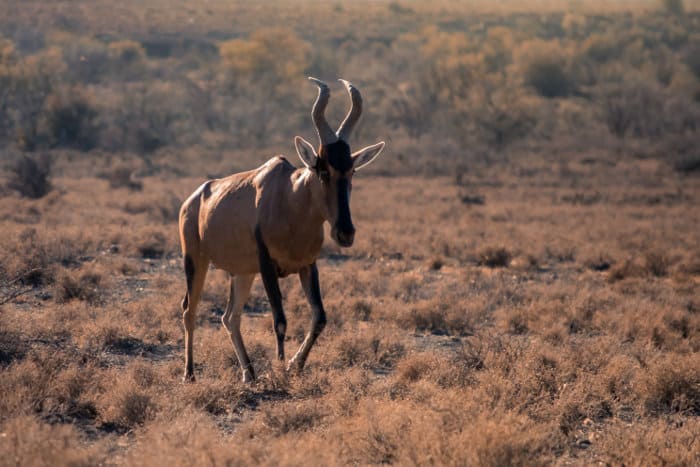
"Hartebeest" comes from the words "tough ox". From far away, they look like slightly misshaped antelope.
They have potent family groups with an established hierarchy among the males. The males will oftentimes forego necessary hydration in gild to maintain the role of alpha in their territory.
That is considering it is common for them to return from seeking water to discover another male has claimed the title of blastoff.
Breeding season occurs in accordance with rains – if there is food and water readily available, regardless of the flavor, they volition brood.
Hartebeest horns
These animal horns are effectually 50 centimetres in length. They curve outwards and away from each other, then back towards each other.
There are likewise ridges. Both males and females grow horns and the length of these horns depends on the age of the animal, as they grow for their unabridged lives.
Nubian ibex
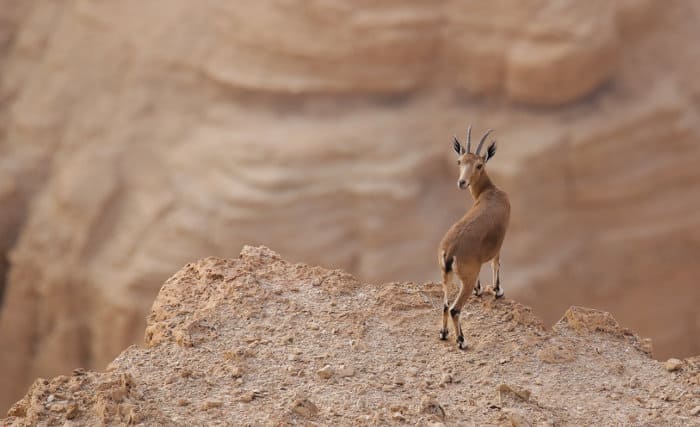
The Nubian ibex looks like a goat with spectacular horns. They dwell around rocky outcrops in mountainous regions, living in social groups of up to 8 individuals (for females).
The males tend to wander alone. But when breeding flavour arrives, the males will join a female person herd for upward to eight weeks in society to mate.
To win this privilege, the males must first compete for say-so. For this, they employ the apply of their large and backwards-curving horns.
Nubian ibex horns
The most impressive matter most these animals with horns is that standoffs take identify at heights, sometimes on the border of a cliff or a rocky outcrop. Nubian ibex are not just fighting each other – a unmarried imitation footstep and an ibex will fall to its death.
Scimitar-horned oryx
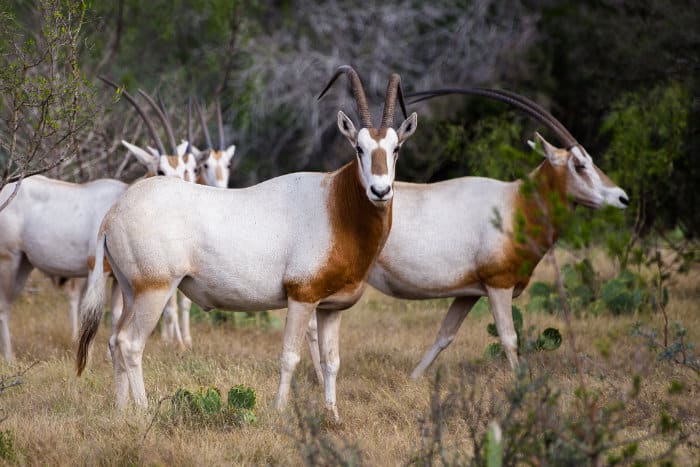
Also sometimes called the Sahara oryx, this beast has been extinct in the wild since the yr 2000.
This was largely due to over-hunting for their horns. At present, they are bred in special reserves. In Republic of chad, at that place has been a successful reintroduction of these animals into the wild.
They require almost no h2o for survival which equips them to dwell in arid regions, like deserts. They don't class available pods or female herds, but stay together in groups of up to 70 members.
Scimitar-horned oryx horns
Both males and females grow long straight horns which have a distinctive backwards curve. The female'south horns are often more slender. The horns are a distinctive characteristic, measuring up to 1.two metres in length.
Rhino
Rhinos are probably the best-known animals with horns in Africa. There are two main species of rhino – the black rhino and the white rhino. They have go a critically endangered species due to poaching.
Their horns are prized by detail cultures. While there are extensive efforts to prevent poaching, it remains a devastating issue which plagues many African national parks and conservation efforts.
Rhino horns
Both rhino species have two horns, though they normally differ in both shape and size.
The black rhino's horns are more evenly sized and rounded at the base.
White rhinos usually have one big horn and i small horn. They look a piffling more 'squarish' in shape as well.
The horns are used for self-defense force and also to assistance them notice food.
White rhinos are grazers and their horns assist them in finding and consuming low growing plant matter.
The black rhino is a browser and tends to eat from copse – leaves, twigs and fruits are its favourites.
Giraffe
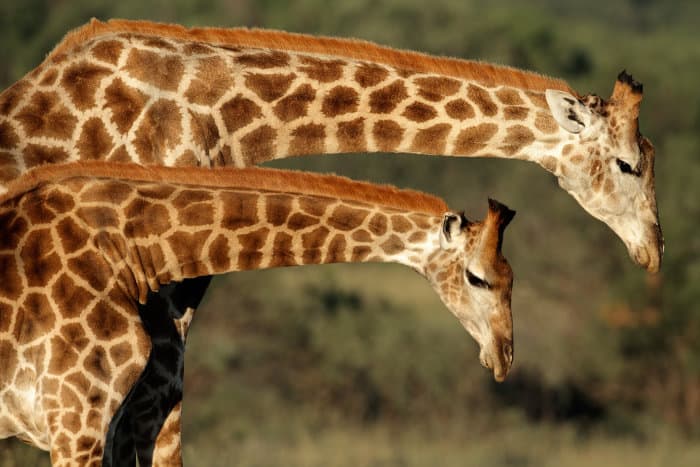
Giraffes are best known for their long necks and distinctively patterned coats. They only drink water every few days cheers to their diet, which is rich in water-dense plants.
Giraffe have four stomachs to assist them process the roughage and the cellulose-rich constitute matter that they eat.
When the giraffe calf is born, it can fall a considerable altitude from its mother to the basis. Nonetheless, inside a day a calf is potent enough to run aslope its mother.
Giraffe horns
A giraffe's horns are called ossicones. The exact reason for their existence is a mystery. Nevertheless, giraffe often utilise these ossicones in self-defense.
They use the horns by swinging their heads and necks violently from side to side, often connecting their enemy with those horns.
Not all giraffes take 2 horns, some accept three. Ossicones look like antlers but they're covered with peel – so they're not. They're also different from horns. They feel similar to the legs of the giraffe, firm but also slightly fuzzy.
Discovering Africa's Animals With Horns on a Safari
Which fauna with horns is your favourite? The large and majestic, the stinky, or the svelte?
Don't wait too long because some of these animals with horns are already extinct in the wild. So perhaps it'due south time to continue safari to encounter these magnificent creatures.
Source: https://africafreak.com/african-animals-with-horns
Posted by: deanclinter46.blogspot.com
0 Response to "Which Animal Is Born With Horns Giraffe Buffalo Rhinoceros Or Reindeer"
Post a Comment